Are We All Voyeurs Now?
New lenses, perfect eyesight, and a yoga class in Isola where everyone is watching everyone.
· 6 min read
For three weeks now I've been sleeping in my contact lenses. They're called ortho-K: rigid lenses you put in at night that gently reshape your cornea while you sleep, like braces, but for your eyes. In the morning you take them out and you can see. After fifteen years of fogged-up glasses and lenses lost down the bathroom sink, I woke up with perfect 20/20 vision. Nobody warned me how detailed the world is.
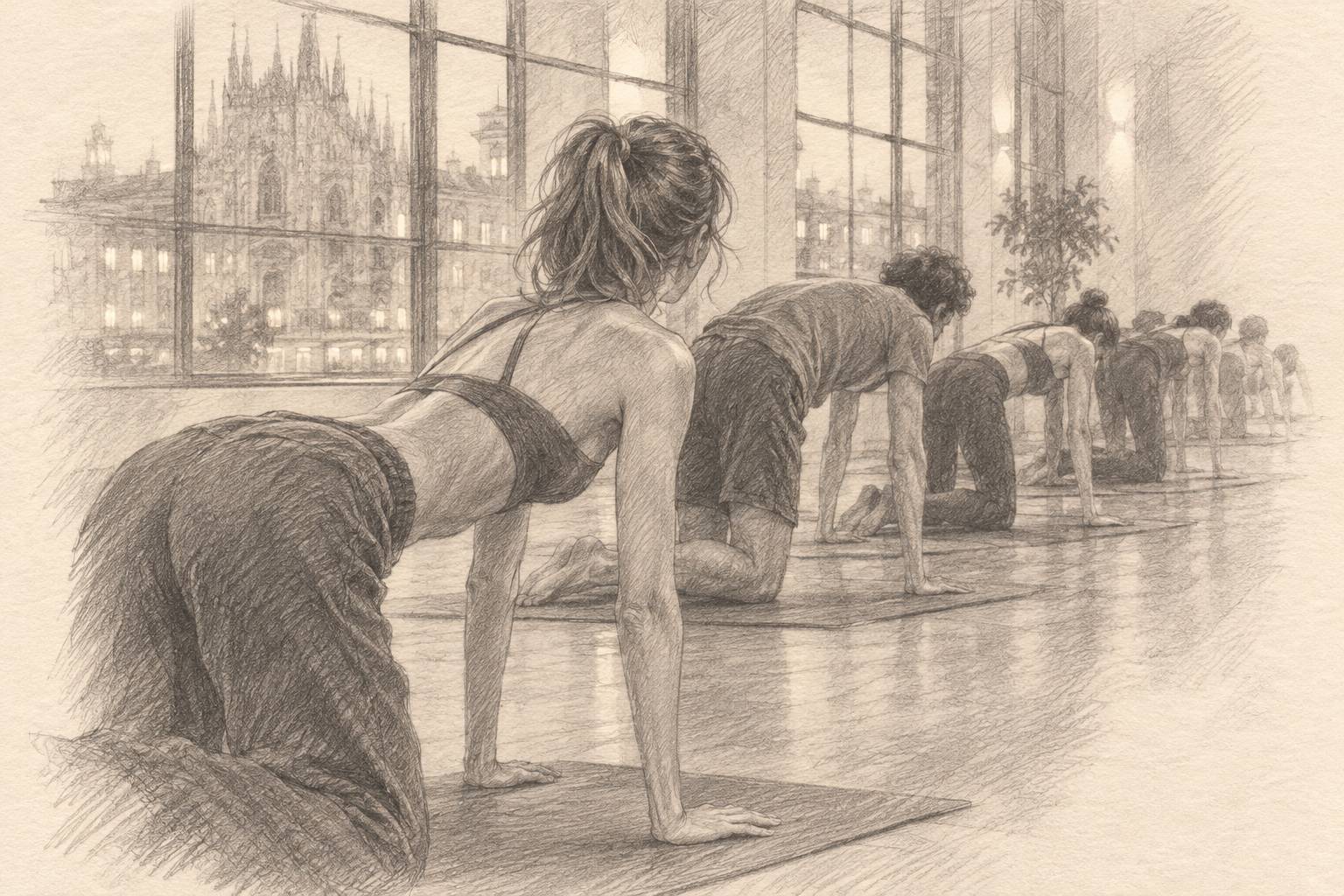
Tuesday night, seven o'clock sharp, yoga. The studio in Isola was packed like a tram at rush hour. It's a drop-in class, so every week new people turn up with a mat under their arm, find a free patch of parquet and start breathing the way they're told. I've been going for two years, but for two years I saw it as a watercolour: soft shapes, pastel colours, the teacher's voice somewhere up front. On Tuesday, for the first time, I saw it in high definition.
We were in cat pose: knees on the mat, hands under shoulders, back arching toward the ceiling. I turn my head slightly toward the guy next to me and notice he's staring straight ahead. I follow his gaze. In front of him is a woman in the same pose as me, knees down, bottom up. And he has that face. Calm, absorbed, vaguely grateful. The face of a man enjoying the view.
And with my brand-new eyesight, instead of judging him, I find myself checking her leggings too, just in case of any accidental see-through moment. Female solidarity, I tell myself. Sure. Then the next thought arrives, as unavoidable as traffic on Viale Monza: what about behind me? I turn around. There's a guy. Same face. Suddenly I'm thinking about my own leggings, how many times I've washed them, how thin they've become.
From there it's a chain reaction. My eyes sweep the room: rows of arched backs, and behind every back, a gaze. The same expression, repeated down the line like a factory floor. A whole room of people looking at whoever is in front of them while someone else looks at them. Namaste.
I walk out into the November dark, yellow streetlights on wet leaves, and the feeling follows me down Via Borsieri. Now I can see the looks. They come toward me, rest on my face for a second, slide down to my legs, my shoes, then move on as if nothing happened. And I do the same to them. How you walk, how you sneeze, how you carry your bag. A small voyeuristic ritual passed from stranger to stranger all day long, and until three weeks ago I had never noticed it. Maybe because, quite literally, I couldn't see it.
So I have to ask: have we become a society of voyeurs? And if we have, where does the ritual start, and where does it stop?
Lou: that's how it works
That evening I bring it up with Lou on the sofa, while she eats yoghurt straight from the pot. She looks at me as if I'd asked whether water is wet.
"Of course everyone looks at everyone. It's normal."
Then she tells me about her Pilates class. On the mat next to hers there's a muscular guy who does the star: a side plank on his right arm, top leg lifted high, his body one straight line from heel to shoulder. His whole side is drawn tight as a bowstring, shoulder, obliques and thigh trembling just slightly, as if gravity were a suggestion he has decided to ignore. And she watches him. Every single time.
"But do you watch him because you like it, or because it's impossible not to?"
"No, I like it." She shrugs. "That's how it works."
Coming from someone who pays her rent by being looked at, it carries a certain authority.
The menu
So where does it start? I have a theory, and it's in my pocket. We open a dating app and flick from photo to photo with our thumb: face, smile, mountain selfie, gone. Next. It's the same gesture as on the sites where Lou posts her photos: image after image, body after body, never really stopping on anyone. We've trained for years, and now we do it without a screen. Face to face on Via Borsieri. Bottom to bottom in a yoga class.
So is that enough? Do Lou's photos satisfy us completely? If every day we carry a date in our pocket with people we can look at exactly the way we'd like to see them, in the poses we'd choose ourselves, why would we ever need to talk to them? The smile arrives perfectly lit. Nobody snaps at you, nobody has spritz breath.
And I don't think it stays on the phone. If you spend all day looking at bodies in poses, you keep doing it when you walk outside. You look at strangers and, without meaning to, you pose them too. So when, exactly, do you feel like stopping in front of someone and saying, "Hi, fancy a drink?" Not in yoga, obviously. Or maybe yes. Why not, right after the sun salutation?
Maybe because, quite literally, I couldn't see it.
The end of the line?
People say flirting in real life is dead, and that this society of voyeurs is the end of the line: we look so much that we have no energy left to talk. I'm not so sure. Maybe looking is just the first step, like reading the menu before you order: it tells you what to expect, makes your mouth water, helps you decide. Nobody ever walked out of a restaurant just because they'd read the menu.
Or maybe they do. Maybe reading the menu has become so satisfying that we leave the table already full.
So here's the real question: is looking good for us or bad for us? Does it spark our curiosity, or does it simply satisfy it?
To bend or not to bend
Next Tuesday I'm going back to yoga, with my brand-new eyes. I'll look, because apparently I can't stop now. But maybe, at the end of class, while I roll up my mat, I'll bend a little toward someone I've been looking at. To bend or not to bend: that's where the menu becomes dinner.
Small steps. And maybe a coffee.
Until next week: bend a little.
Camilla